Welcome to my English 2010 Intermediate Writing page! Below you will find some of my writing that I had written as I took this class. Please Enjoy!
NOTEBOOK 1
- Write down an abstract question about your issue that you would most like to explore through creative writing. Freewrite about a group of events, people, organizations, places associated with that question. Meditate on the question, alternating your meditations with the actual event, people associated with the issue, and the causes/effects of the issue, etc. After your freewrite, explore sources that could help you flesh out your exploration of the question.
Faithful or biased?
Not too long ago in October 2015 there was a change in church policy of the Church of Jesus Christ of Latter Day Saints. The change in this policy was to initially prohibit children of same-sex couples from being baptized and confirmed a member of the Church. This change created an uproar among the members of the Church and the LGBT (Lesbian, Gay, Bi, Trans) community, especially those individuals who belonged to both communities. When the change actually happened (just after the supreme-court deemed gay marriage constitutional in America) is also to be taken into consideration, as LGBT members of the Church prior to the policy didn’t have a problem. However, change in policy does not only affect those members of the church in Utah, but actually affects everyone in the whole world! This is a world-wide religion! If anyone may ever have the wish to join the Church of Jesus Christ of Latter Day Saints, they must agree to conform to the Church’s views of and standpoints against the LGBT community. Such standpoints mainly agreeing to disavow any practice of same-sex marriage.
The LGBT community and the members of the Church already baptized aren’t effected nearly as much as the children are, and that’s where the problem lies. Is it morally right to treat the children of LGBT individuals differently than the other children at church, not permitting them to be baptized like all the other kids? Is it right to put a “scarlet letter” on their chests until they turn 18 years old and disavow their parent(s)? But more importantly, is this really how God would be treating innocent kids?
The problem isn’t in the policy itself, but among the people of the church. Too many “just believe” what they’re told and when they’re confronted, they “turn their ears off” and don’t think for themselves. Is such an attitude among those in the church who believe in intelligence, reasoning, and wisdom truly justifiable if they don’t bother to learn the other side of things? Where there’s white, there’s black. There isn’t just white. The absence of light is darkness. One cannot exists without the other. If I only read about good, that’s all I’ll find. How can you know if there’s bad if you don’t look for it. What’s the problem with looking outside the Church’s Standard Works? If the church is completely “true”, then there wouldn’t be any evidence against the truthfulness of the church and there shouldn’t be any hesitation to increase your knowledge about it. I often have this conversation with people. They tell me I should read my scriptures, I do. I tell them they should listen to this podcast, they don’t. Why? Because it’s not church provided material, so it’s incredible and not worth their time to them. Is that being faithful, or is that being biased to resources?
I’m not afraid to read everything and gather information to create my own logical opinions and standpoints. The ignorance of members in the Church is the issue I have chosen to write on. There are many causes and effects resulting from this ignorance, including a mass church resignation due to the policy change, as people’s eyes were further opened. People in the church should ask themselves is if this church is right for them, meaning, do they believe and agree with everything the church teaches and the policies therewith? Will you stick to what you know and continue to follow completely aware of the possibility that there is evidence out there of things that could dissuade you of the truthfulness of the church’s teaching and policies? Do you owe it to yourself to find out for yourself? It’s not my salvation.
Notebook 2
- Tell someone about your writing project. Or: imagine telling someone about your writing project. What are the most important parts of it? What order would you tell it in? What parts of your writing project would you leave out in this telling? Why?
To begin, I actually have talked with quite a few people about my writing project. I have received a variety of reactions, actually. I feel as though I introduced my topic similarly each time in order to fairly conduct the experiment. I want to tell of the time I introduced my topic to my LDS (Latter-Day-Saint) Institute teacher. He was actually my seminary teacher in high school as well, so we go a while back. Anyway, I started out with some small talk and then he asked when I got home. Most people usually ask me this because I was on an LDS mission not long ago. I told him I got home in October, right before the policy change. This is usually how I introduce the topic. Immediately I asked him how he felt about it. I usually like to listen to someone’s input before I give mine. I listened to him tell me about how he though people were blowing it up to be something big when it really wasn’t. He then continued with sharing his experience growing up without the gospel in his life and how he knew it made a difference, even if there was a policy change. He then asked me my thoughts after my patient listening.
I considered these points to be the most important parts of my argument, which I did indeed ask or mention in some way. One, do you think it’s fair to the kids that don’t get to be baptized when their friends do? Two, in a way, don’t you feel at least a little bit that these kids are being discriminated against, wearing a “scarlet letter” on their chest in church? Three, do you think that this policy is acceptable from a doctrinal point of view. Would Jesus, who loves all children, agree with everything you said?
These questions are designed to bring out opinionated views and logical views. Questions that bring out opinion first, so they can take a standpoint on the issue. Logical questions that challenge their standpoint second, so they can either agree with their standpoint or realize something about their standpoint and themselves. I purposely have this order, because my writing project is on people’s ignorance and problems with self-honestly when it comes to having an opinion, perhaps opposite of the church’s.
I don’t know if I would leave out too much of my writing project, because it’s being utilized to convince the person that they need to have an honest opinion with reason behind it, not just because that’s what the church says.
To finish, I asked him these questions and he stuck to his opinion (testimony) that he knows the gospel blessed his life and that’s good enough for him. I told him I respected that, that not a lot of people have lived a difference without the gospel like he had. I thanked him for being a person that has given it honest thought and taken a stand. I told him how I have come to know too many people that have a certain opinion just because the church said one for no personal reason at all. It’s these people inside this church that I’m writing for. I want them to believe with reason.
Notebook 3
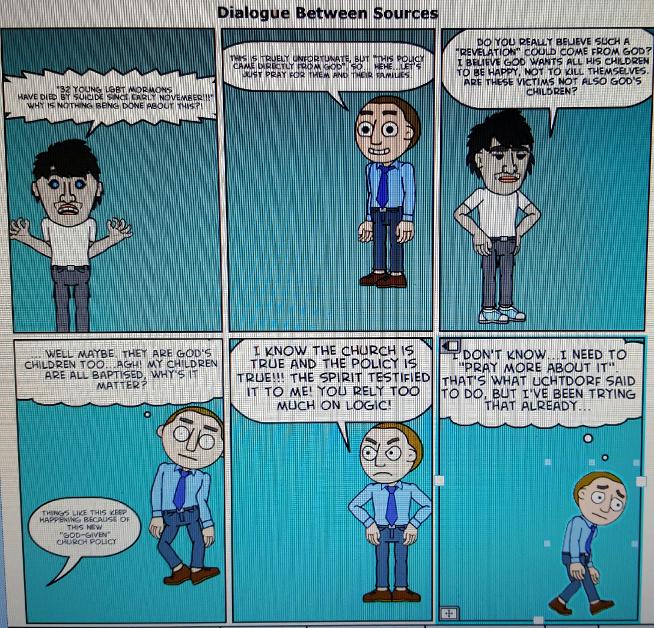
4f. Create a dialogue between two of your sources. Make it a comic or an GoAnimate film if you'd like. Make the voices talk to one another--you can quote, but don't only quote. Use your own summaries and paraphrases, too. See where the sources agree and disagree and where they diverge entirely.
Comments: This is a comic of a mormon guy hearing in on a guy complaining about the change in 2015 October change in church policy. They mormon guy tries to justify the suicides because the policy came from god. The white shirt guy slightly takes offense, but begins to take a logical approach to the situation, throwing in a bit of opinion making it somewhat persuasive and rhetoric. The following reactions of the blue shirt guy is what normally happens when asked such questions and hearing statements in such a way. When in all honesty,most don't really now for themselves...
The sources agree with children being from god, and that suicide is not okay. However, one source has a different opinion where the source of the policy change came from, from another. One source tries to take action to make a change, where the other dismisses it and moves on. Point is, children are dying because of the way they are being treated at church and nothing is being done. I decided to write on this because It's my most recent source for this project. I heard it on the radio this morning and then read it later today. This problem is real.
Sources:
Blueshirt guy, the policy helps protect children:
(MOST RECENT) http://gephardtdaily.com/local/mormon-church-responds-to-claims-of-spike-in-lgbt-suicides/
http://www.deseretnews.com/article/865646414/LDS-Church-leaders-mourn-reported-deaths-in-Mormon-LGBT-community.html
https://www.lds.org/church/news/elder-christofferson-says-handbook-changes-regarding-same-sex-marriages-help-protect-children?lang=eng
White shirt guy, the policy is harming children:
Profile Assignment Draft
Notebook 4
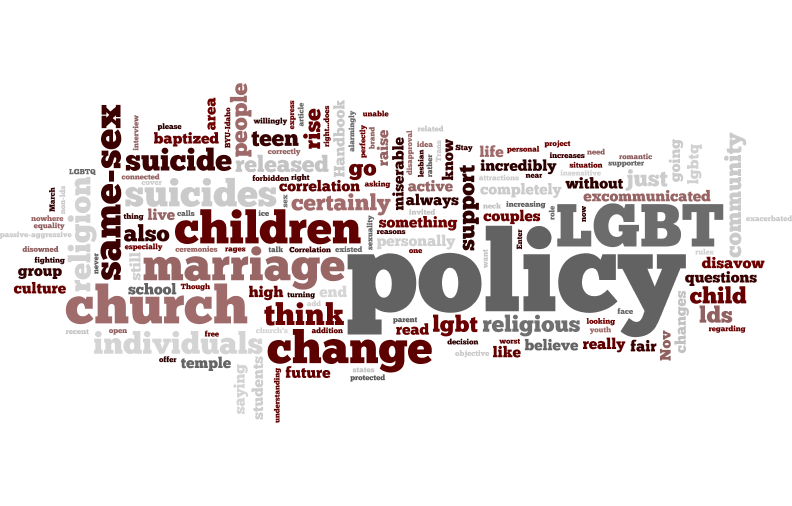
- Use Facebook, Twitter, Instagram, and/or Pinterest as a way to explore how people communicate messages/information about your issue. Try posting some information about your issue and then pose some questions to your audience. What happened? Explain why you think you received the answers/feedback that you received. Create a Wordle word cloud with all of the responses OR create a collage of the photographs and other information that was offered.
I took the initiative and posted the following post on my Facebook wall:
“With the suicides of lds, lgbt youth continually increasing since the change in church policy in Nov 2015, is it safe to say the children of lgbt individuals are being protected like the policy change intended? do you think there is any correlation between the suicides and the policy change? Do you personally believe the policy change is fair to the lgbt children? If you read to the end without disgust of me asking such questions and are open minded, please comment your opinion to the questions above. I'm doing a school project that calls for your feedback on this issue. Thanks!”
I received the following comments in this particular order:
1) “I think it's incredibly insensitive for anyone to believe the policy change and the recent rise in lgbtq suicides are not connected. LGBTQ people who live within the church's rules have an incredibly difficult life fighting their attractions and their faith at every major and minor life decision. To brand perfectly normal people apostates for simply living their most natural selves is nowhere near the idea of Christ-like love.”
2) “I would need to read an article or something relating to this but if I am understanding this right...does this policy have something to do with the LGBT community? I mean in the situation it sounds more like the correlation thing between a summer day where ice cream sales go up as well as road rages increases.
I personally am not religious so as far as religion go I do not really have a personal statement but as a LGBT supporter (and if I am reading this correctly), with LGBT it has always been a struggle especially through religion. Is it fair to the children that are LGBT? No...because no matter what, LGBT is still looked down upon by those who do not understand that these are still human beings.”
3) “Even before this policy, the church certainly played a role in LGBT suicides and policy change certainly exacerbated the problem. The church is filled with systematic homophobia. It's built right into doctrine and policy in addition to the culture surrounding the church. A conversion therapist was invited to BYU-Idaho, only 27% of Mormons support marriage equality, etc. Trans individuals in particular are denied entry into the temple and are barred from any ceremonies that match their gender identity, that is if they're not just excommunicated.
Besides that, what future does the church offer gay and lesbian individuals? Stay celibate and miserable, unable to express any romantic attraction they feel? Enter into a miserable, unloving heterosexual marriage to go through the temple? Embrace their sexuality to, at best, face passive-aggressive disapproval from their family and community or, at worst, be completely disowned?
The policy released in November 2015 was not willingly released by the church; it was released because Handbook 1 was leaked to the public. I think the justification of protecting children was a cover to justify the policy after the leak. In March 2015, Christofferson stated in a KUTV interview that church members are free to support same-sex marriage without fear of any religious punishment. However, Handbook 1 states that upon turning 18, the children of same-sex couples are required to "specifically disavow" same-sex marriage in order to be baptized. Why is it that the group that has one of the biggest reasons to support same-sex marriage is also the group forbidden from supporting it?”
4) “I wouldn't say the suicides are directly related to the policy changes but rather the culture and general attitudes towards the lgbtq community and individuals that has always existed. Though those changes certainly add to that.”
5) “Correlation or causality? Is LDS teen suicide on the rise or do people notice it more and associate it with the policy?
We live in a completely non-lds area, over 1700 students in the high school with less than 15 lds students (active and not active). In our area teen suicide is alarmingly high, but has absolutely nothing to do with the lds religion. Being objective I have to wonder if the Nov 2015 policy regarding children of same-sex couples is really the cause of suicide. I'm not in Utah so I don't know what is going on there, I just know suicide is on the rise in my neck of the woods too and isn't attributed to any religious policy.”
6) “I would say yes if it were the parents of a LGBT were told to disavow their child or be excommunicated but it's not. So I say No! I'm saying that also because why would you want to raise a child in a same sex marriage, in a religion that would do that to you as a parent. You wouldn't. I also don't think some LGBT teen is looking into the future saying; I can't raise a child with my spousal unit because he/she will never talk to me again when they're baptized so I'm just going to end it now! Nope!”
7) “Yes. The suicides are an individual problem with that person and should not affect the children except in the loss of a loved one. The person committing the sucide has chemical imbalance or a mental disease undetected. We had a young man who lived across the street from us and was active LDS'S who had problems from the time he was born who committed sucide because he could not logicaly think through sitituations. My oldest son also had a active LDS friend who committed suicide but his was due to family problems. I do not feel that there is any correlation between the suicide victim and the church policy. The policy did not say that the children could not attend the church of there choice but I feel the problem arises because the lLBGT choose not to live the culture of the nation which states that one man and one women married constitues a family . All the church said was that children of LGBT'S should wait until they are of legal age to choose what life style they want. Children follow the example of caregivers and parents . They learn by modeling their behavior. Yes the policy is fair and very loving in giving the children a chance to compare the life style they have grown up with and the LDS Church. The LDS Church is an organization and those who want to belong must abide by the Churchs laws. The LBGT'S want to pick and choose what laws they want to live instead of abiding by all the laws of the church. It is not a constitutional right that the LGBT'S try to make the church conform to their way of thinking as hard as they try to push their agenda. Also every socialst will tell you that these type of people will always blame someone else for their problems to satisfy what they are doing and are unable to take responsibilty for their own actions.”
As you can see, I received a variety of comments to my post. There were supportive, unsupportive, and also a neutral comment. I think I received some good answers particularly because I requested that if someone were to post, they be open-minded about the subject. I felt my questions were pretty good and straight forward and caused for a good discussion. I am very satisfied with the responding comments I received.
Notebook 5
- PART ONE: Tell about a time when you were an outsider. Describe your thoughts, feelings, and actions as someone outside the dominant group. PART TWO: How could your experiences help you understand the experience of people in subordinated groups? How will these considerations affect the rhetorical situation you construct in your next genre piece? (Think audience, credibility, message, purpose, etc.…)
Part One: I remember feeling like an outsider on multiple occasions. I think I want to tell you about the time I played basketball in Junior High School. It was my ninth grade year and unfortunately I hadn’t made the team the previous years after trying out, because I wasn’t that great of a player. After I had failed twice, I really spent the next year after, working at all my basketball skills. I got pretty good for my age and blazed everyone at tryouts to the point where I was a starter for the varsity team. I had respect among my peers and teammates for that. I had met one of my first long-term goals then and felt really accomplished. I had never played in a school basketball game before at this point. It was the first game of the season. I was excited to play, but unbelievably nervous. The game started, ball was tipped us. I ran to my spot on wing to get ready to drive. The ball was passed to me. I caught it, but immediately dropped it. It had slipped through my hands because they were SO sweaty since I was so nervous. I picked up the ball and even again, it slipped through my hands despite what I did. I was so nervous and knew lots of people were watching me, especially the pretty cheerleaders. My opponent eventually got the ball and took off. We eventually got the ball again and the ball was again passed to me. Same thing happened again despite how many times I told myself to calm down and relax. I knew I was on par or better than most of these players, but my reasoning wasn’t working. I got pulled out and benched. Everybody on the bench just kind of stared at me because I was a starter and was supposed to be one of the best on the team. I had one friend on the team, a junior varsity player. He asked me what was wrong and I told him. It was uncool to be friends with the JV players, but I didn’t care. My coach didn’t put me in a single varsity game after that for the rest of the season.
I was an outsider from the varsity team I once called teammates, all because I got nervous my first game, ever. One person that used to respect me belittled me a lot in the locker-rooms the rest of the season. I could tell I wasn’t wanted on the team anymore and everyone treated me so. I didn’t let it get to me though. I knew I was better than them and didn’t have to treat others like crap to make it known. I went the whole season being though and treated as such, but the last game my coach put finally put me in a Varsity game after much nagging from the entire JV team and myself. I did really well and didn’t drop the ball once. I wasn’t nervous. After the game, the Varsity team came up and told me how they were surprised because they thought I sucked. I told them what I had been telling them all along and told them how they cared more about their self-image than to listen to an ex-Varsity player/ JV player. The person that had been belittling me the entire season continued to do so and said I just got lucky. Everyone said I should challenge him to 1 on 1. I did so and the end of the season beating him 21 to 9. He was supposedly the best player on the team, being the tallest and cockiest. The season ended and I retired from playing school ball despite my friends’ requests for me to play in high school. I had decided I didn’t want to be around people that put down others like these jocks did. I switched my sport to swimming where all types of people were accepted.
Part Two: Once I had experienced everything from basketball, I learned how I definitely didn’t want to be treated. I promised myself that I wouldn’t treat anyone like that. I told myself if I ever met someone that wasn’t that great like I was, that I would be nice to them and encourage them, because I know exactly how they feel. It doesn’t feel good. I’ve actually do this a lot still. In water polo, I will still tell people, “don’t worry about it”, “All you can do is shoot and hope for the best, because that’s the honest truth”, “nice try, you’ll hit it next time”, etc…. instead of being like the typical person who won’t pass to the person anymore, or won’t talk to them, or makes rude remarks, etc. I like to call it sport-bullying. When I see people in these subordinate groups, I feel compassionate. I know how they feel.
I feel like I actually do apply this to writing a lot. Actually, not only writing, but also in real-life situations. I always try to “put myself in others’ shoes” because it helps me to understand and see where they’re coming from. It’s the same with writing. I try to understand how the audience will react, make assumptions about how they will think to my writing, credibility, message, etc… It’s as though they have needs and my writing needs to fulfill those hidden needs. They may not be so apparent on the outside but if you really think about someone and try to understand how they feel, you can get a good lead to how you want to compose your message. For example, my profile project. I did a video on the LGBT youth suicides. The video was designed to fulfill the needs of multiple audiences. For the LGBT members that watch the video, it well help them to feel a support and acceptance, that there are people out there that care. This all plays into how convincing and persuasive your writing is on the reader. The goal is to make an impact on the reader and this definitely helps in doing that.
Notebook 6
- Write two lists entitled "What I Know" and "What I Don't Know” about my issue. Develop a list of possible resources that you could help you explore what you “know” and find answers to what you “don’t know” about your issue.
List one (What I Know):
- LGBTQ individuals in the church are mistreated and underprivileged
- There’s a rise in suicides among LGBTQ members of the church after the policy change
- Policy change in unfair to LGBTQ members of the church
- Policy change contradicts own church doctrine
- The church won’t do anything about how this minority group is being treated, no letter, nothing
- Groups are there to support the members of the LGBTQ community
List Two (What I Don’t Know):
- Percentages of gay Mormons in the USA
- If the stigma against LGBTQ Mormons is only this strong in Utah
- A backstory about one of the people to create a sense of ethos
- Possible parallels to politics and mistreatment of minority groups in history
- If most Mormons care enough to say or do anything
- Groups that are Mormon and Anti-Gay
- What Mormon doctrine exactly is, since revelation seems to overrule doctrine
Possible Resources:
- Story and background of LGBTQ person that committed suicide
- Suggestion of letter and love for LGBTQ individuals in the church
- Meet with LGBTQ group advocate, # of people supporting; mass resignation
- Demographics of LGBTQ, USA
- Statistics of practicing, loving, LGBTQ supporting Mormons
- LDS church data
What I found:
http://www.washingtonblade.com/2016/02/05/moms-of-mormon-gays-track-teen-suicides/
http://www.sltrib.com/news/lds/3473487-155/suicide-fears-if-not-actual-suicides
http://outsidethebookofmormonbelt.com/2016/01/28/numbers-tell-the-story/
http://tobingrant.religionnews.com/2015/04/27/five-things-know-mormon-politics/
http://www.vanityfair.com/news/2012/10/mormon-politicians-lds-church-romney
http://radiowest.kuer.org/post/lgbt-suicide-and-lds-church
If you read the titles of the articles I found, you’ll see I actually got a lot of my questions either answered or partially answered. A lot of what I knew was reinforced as well. I’m going to use these in my papers for now on to further strengthen my argument, as well as study in my free time as a hobby.
Notebook 7
- Write a haiku that explains what your essay is about. Write another haiku that explains what your essay is really about.
Haiku 1:
Policy changed lives
Gay children are mistreated
Mormons support it
Haiku 2:
The church is a cult
Members don’t think for themselves
Or are afraid to
Report Assignment
Below is an informative report I did on the policy change and the effects of it among the LGBTQ community. Please Enjoy

|
Report on policy change final 1.docx Size : 261.95 Kb Type : docx |
Notebook 8
- Write a Letter to the Editor of your Online Magazine/Newspaper in which you use satire to propose a ridiculous solution to a problem explored in your Position or Proposal essay. Try to model your letter on Jonathan Swift’s “A Modest Proposal.”
Dearest Editor of my online magazine,
As you well know, there are too many gay members of the church that want to go to the temple. We don’t want their kind in there and they just don’t get it. And I wrote this here same letter to the prophet, so it’s gonna happen. I would like to make a phew propositions to fix that. Firstly, we need a big sign on the temple gates that says, “No Gays”. I mean, it’s the truth, ain’t it? I’ve always been a man of great character and if I was one of the gays, I‘d like it told to me straight up., instead of doin’ one of them fancy, policy-changes. Come to think of it, them gays have a lot of children. We better get them their own sign, too. One that says, “No Gays” and one right underneath it that says, “especially not your children”. Trust me editor, this is gona work.
If we can get those big signs, one for each gate, them gays ain’t gonna want to come to church no more and steal all our sacrament bread. Just this last Sunday, I saw one grab the biggest piece of sacrament bread, the same piece I was gonna grab. I know you’s thinkin’ the same thing I was thinkin’. “The son of a bitch gonna need the biggest piece anyway, ‘cuz he’s gay. Hell, their kids shouldn’t even take the bread since they’re taintin’ all our pure-mormon kids. Ain’t no baptism that’s gonna fix their gay. You and I both know that and before word gets out, I propose we secretly stop letting queer kids get baptized. No one will ever find out.
I’d gone and read my first book the other day called “A Modest Proposal”. It gave me a lot of good tips and helped me come up with ma last idear. Since our baptism don’t fix ‘em, our kids can. Now bear with me for a moment. I ain’t gonna say something crazy like teach our kids to be examples and strengthen their testimonies of heterosexual-marriage in order to create a potential causation among the LGBTQ Mormon community, like we’ve been don’ already. Nope, better. You read this book and you gonna know where I’s comin’ from.
Our kids, they got the power, they got the priesthood. The priesthood can cure the gays. All we gotta do is sacrifice one kid every month that’s at least a deacon, cut ‘em up into cube-like pieces, and put him on a separate sacrament tray for the gays. It’s like takin’ medicine, editor! Gonna fix ‘em right up. And if we have leftovers, we can freeze them and save them for the next week. Now I understand the queers are gonna need a good size piece every week, so that’s why I thought a kid a month would do. See editor, I’m smarter that you give me credit. Not you may ask, why the kids and not the high priests. Well, think about it. The high priests don’t look very appetizing and they don’t got very much meat. We can use them in VERY special cases, since they have a higher-quality priesthood, but I think the deacons will do. The gays will want to eat them because they’re more attractive at that age, so it’s gonna workout. We have enough deacons anyways, we might as well use them.
Well editor, if we build a sign, and then build another sign, then feed them gays our kids, our religion’s gonna stay just how brother Joe woulda wanted. I know this here is revelation from the almighty, he told me himself. He told me you should at least make the signs and take away baptism from the children, but especially to tell you to pray about the cure to gayness. You should read that book I was talkin’ about. Good stuff, gives ya revelations just like ours does! I’m livin’ proof.
Your Loyal Follower,
Some gay-hating official of the Church
Notebook 9
2h. Re-write, verbatim, a passage from one of your sources that contains the author’s thesis. Reflect, in your Writer's Notebook, what you learned about contextualizing and crafting a thesis statement from this exercise. Write a counter-thesis statement for your source’s original thesis. Mimic their style to help write the counter-thesis statement. Freewrite what you learned about contextualizing a subject and stating a thesis from this prompt.
Source’s Thesis:
“On November 5, 2015 the policy change to LDS Handbook 1 regarding homosexual members became known to the public. Since then, in the US, 34 LDS LGBT young people between the ages of 14 and 20 have committed suicide. The numbers are being tallied by Wendy and Thomas Montgomery, leaders in the Mama Dragons and Dragon Dads support groups for LDS LGBT families. That’s 1 suicide every 60 hours, or every 2 ½ days. That number does not include a count of suicide attempts, nor of suicides by any closeted LGBT young people. Twenty-eight of these suicides occured in Utah, a state that averages 37 youth suicides in a 12 month period. Thirty-four in 84 days is a stunning statistic. It’s horrifying. And gut-wrenching. It is also telling. It tells us we adults are not sucessfully supporting our LGBT youth.” (http://outsidethebookofmormonbelt.com/2016/01/28/numbers-tell-the-story/)
The author is obviously making a claim there that there is a rise in LDS LGBT youth suicides due to the policy change in Handbook 1 of the Church of Jesus Christ of Latter-day saints. I thought It was interesting how in the thesis, evidence of numbers was already being used to strengthen her point. I typically don’t put too much evidence in my thesis, instead I make a claim. I don’t necessarily think it was a bad thing because it helped strengthen her point early on that there is a problem. It caused me to be more intrigued and made me want to continue reading further.
Revised, counter-thesis:
On November 5, 2015 the policy change to LDS handbook 1 regarding homosexual members became known to the public. Sin the, in the USA, groups, such as “The Mama Dragons” and “Dragon Dads” that support LDS LGBT families, began tallying number of suicides among LDS LGBT youth as a way to retaliate against the church’s decision. An apparent rise in suicides does not necessarily indicate that it was causation of the policy change, as the numbers and data gathered is still too inefficient to strongly support that claim. Leaders of such organization continue still to support against “mistreatment” to LDS LGBT youth, although all the church did was change a policy within its own walls.
Notebook 10
- Return to an essay you have written. Revise the essay, making some kind of major adjustment—reworking your thesis, starting with the conclusion, changing the narration (in the memoir or profile), cutting it by a third, etc. Or translate it into a PSA, audio essay, video essay, graphic/hypertext.
Spencer Rosenvall
Professor Waldron
English 2010
20 Jan 2016
A Call to Serve
“First, to young men of the Aaronic Priesthood and to you young men who are becoming elders: I repeat what prophets have long taught—that every worthy, able young man should prepare to serve a mission. Missionary service is a priesthood duty—an obligation the Lord expects of us who have been given so very much.” That’s what their Prophet had told them. That day he felt like he had to serve a mission, that it was no longer a free-willing choice, but a required duty. “Why wasn’t I honest with himself earlier?” he asked himself as he ponder on those days. The same days that were long, the days that were hard--and nearly every one of those days were the same. Wake up at 6:30, study for 3 hours, proselyte on the street till 9, sleep, do it again. He never really liked my dress pants, and his white shirt always seemed to choke him at the collar, every day, getting tighter and tighter, no matter what he tried. Our leaders told them to try studying more, try praying more, it’s just a trial and to bear through it, but regardless, he was still suffocating. He thought it was where he was supposed to be at the time, but he, along with many others, didn’t really belong there.
Receiving a mission call to Germany, his family was excited and happy for him. Inside, he wasn’t excited at all, but his family seemed to appreciate “his willingness to serve”. A peculiar look almost spoke as if it wasn’t so sure about everything, not particularly exited either, but felt like it was something that had to be done. On his mission, he spent countless hours studying the church-sanctioned materials provided to him as a missionary. He studied, well, because they said to, but not only because of that—he desired to know the truth for himself. The bible teaches the truth would set me free “Holy Bible, New Testament, John, Chapter 8, verse 32”. Free from what? The chains of hell or in other words our own unknowing, claims Alma in the Book of Mormon “Book of Mormon, Alma Chapter 12, verse 11”. He knew that was where he definitely didn’t want to go. The others that encompassed him probably felt the same way. Curiously, he would ask his companions what they thought about certain doctrines, their opinions on things, but most were content with not knowing or having their own opinion! Why were they afraid, or what of? He felt alone and continued studying, looking for answers that were nowhere to be found. Whenever he was “blessed” with an answer to his question it was like a gasp of fresh air, but whether it was right or not he did not know. This troubled him and the lack of answers caused my uneasiness to grow. He knows he wasn’t the only one of these missionaries that felt this way.
Every day that passed was harder and harder. The mission presidency tried to “help” him, telling him how he would regret such a decision. He did what they had asked of him, but everything they promised would happen, didn’t. He asked himself if there something wrong with him, or if I’m just being honest with himself. Either way, he was getting very depressed. Some days he would look at himself in the mirror in the morning and as the days went on, the look on my face became ever so more emotionless. One month before he returned home, he looked once again into the mirror and to my surprise, yet not surprised, he was staring into empty eyes. The same empty eyes he had seen in a few other missionaries. He understood at that point how they too were feeling. It was the feeling of anxiety and dissatisfaction growing toward himself.
The day came where he couldn’t breathe anymore, and he suffocated. He was, like many others, on the verge of just ending everything there. Fortunately, he stayed strong and returned home to my friends and family very afraid to receive their judgements, but the anxiety he was experiencing wasn’t worth staying out anymore. He tried to speak with them about my journey, what he learned, what he experienced, and most importantly, how he felt. Most shunned him and considered him unspiritual and dishonorable, someone who apparently has left the true path to heaven. He didn’t blame them, he would have acted the same way while he too was afraid to look beyond what the church told him. I knew if something was true, it couldn’t be disproved. The church could either be true, or it couldn’t be, and he knew it was my personal responsibility to know and find that out for himself. Learning how I really feel about things and what my honest opinions are helped him to succumb with the drama when he returned home, because at least he was being honest with himself now.
He wishes the others who were pressured to serve a mission could be just as honest with themselves, and escape the same hell I felt. We all should just be honest with ourselves from the beginning. Families should accept their sons and daughters for who they are and what they believe. They shouldn’t pressure their youth to serve a religious mission, it should be served willingly. For all they know, they could be digging their child’s grave.
Works Cited
Smith, Joseph. The Book of Mormon: An Account Written by the Hand of Mormon upon Plates Taken from the Plates of Nephi. Salt Lake City, Utah: Church of Jesus Christ of Latter-day Saints, 1981. Print.
Uchtdorf, Dieter. "Come, Join With Us." Lds.org. Ensign, 1 Oct. 2013. Web.
The Holy Bible: Containing the Old and New Testaments Translated out of the Original Tongues: And with the Former Translations Diligently Compared and Revised, by His Majesty's Special Command ; Authorized King James Version with Explanatory Notes and Cro. Salt Lake City, Utah: Church of Jesus Christ of Latter-Day Saints, 1979. Print.
Monson, Thomas S. "A Call to Serve." Enisgn Oct. 2010. Print.
Notebook 11
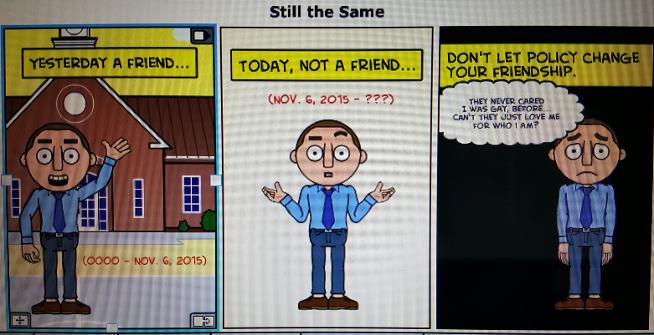
- Write or create a PSA on for your issue in which you explain the causes and effects of a problem associated with your issue. Explain what should be done to address the problem.
As you can see, there is an issue I point out with my PSA that members of the church don't accept the Gay members anymore when they once did. This could easily be solved if people would get over the fact that there is a policy, yes, but they are still members of the church and their friends. A policy change should not change friendship.
This is my final draft for an argument paper I wrote.
|
|
position arguement revision1.docx Size : 22.457 Kb Type : docx |
Final Notebook!
For the last notebook activity, review all your previous notebook work. (This should be easy, since they'll all be posted on the English 2010 page of your ePortfolio...right?)
For this activity, think about the following:
- What were the activities that made you think differently about a project, or about your writing (or research or revisions)?
There were a few activities that made me think differently about my project. Two name two, it would have to be the one where I made wrote a satirical letter to the editor of a newspaper, and the other where I had to write a thesis opposite of what I was trying to prove. I really enjoyed writing the letter, but it helped me to understand more where more evidence was needed to make a stronger, logical point. As for the thesis, it helped me to understand where my argument was vulnerable and needed some work.
- What activities were the most interesting or fun?
Like I mentioned, I really enjoyed the letter to the editor, but I especially enjoyed making the comics and PSA. It was fun to try and illustrate my social justice issue.
- Which ones do you like the best now? My favorite would have to be the PSA I made. It pretty much summaries why I’m writing everything.
- Which activities might you try again, in other writing circumstances?
Probably all of them. I can see where each one would be helpful and depending on the situation I was writing for, I would implement each strategy accordingly.
Respond to these questions, and answer one more:
- Name three new tools or strategies you now have, ones that you can use with some confidence going forward. I definitely feel I can write decent reports now. I understand logical flow a lot better now, too. I understand what kind of evidences are appropriate and most effective for certain kinds of readers. Before I kind of just stuck to logic, but now I can implement emotion in my writing as well to further strengthen anything if I need to. I understand the “how” of that now.
Creative Points- My Booklet
Now that you've turned in your Group Magazine Project, your last task is to write a 600-900 word reflection on the work you've done this semester and post this reflection on the English 2010 page of your ePortoflio.
Post the url for this reflection as your submission for this assignment.
- Call this reflection "On Communicating and Collaborating."
- Make it a hypertext reflection. This means you should embed links to your work on the magazine as a form of evidence: embed the links within your reflective essay at points where you'd like the reader to take a look at what you did in your revisions and on the collaborative magazine. Go Here to learn how to make a hyperlink in Canvas.
- In your reflection, discuss the following:
- Describe your own writing and research process. Why did you select this issue? How did you go about forming your perspective? Did your perspective on the issue change over the course of the semester? How? Why? What specific sources helped shape/reshape your thinking and writing about the issue? Be specific.
- Why did you choose to write in the genres that you chose (for example, why a profile over a memoir or vice versa; why a position over a proposal or vice versa; why a report over a review or vice versa)? Make connections between the different genres, and attempt to evaluate how effectively you made choices about genre and medium to communicate messages on your issue. Be specific.
- Describe your process for creating the translation/adaptation (Links to an external site.)part of the Magazine project. Why did you select a particular essay or smaller projects over others for the translation/adaptation? Explain what you learned about the original by attempting to transform it into something new.
- Describe your experiences with revision and design as a collaborative effort? Point to specific experiences that you had playing the particular role that you performed in the group? How did you interact with others in your group in regards to the roles that you performed?
On Communicating and Collaborating
My writing and research process, I would say, was pretty typical. I had thought about an issue that I was passionate about, one that I could probably never get tired of, and decided to focus my writing for this class on it for the semester. I chose the issue of the unfair treatment to the children of LGBTQ Mormons after the policy change in the LDS church in November 2015. I selected this issue because I just flat out think it’s unfair and see it more as a punishment to the children if their parents so happen to be homosexual. I firmly believe, whether protection of not, the holy ghost can be an aid to those small children as they grow through adolescence, and if the church really did care and want to protect against the evils of the adversary, they would equip these children with the power of the holy ghost to help make the correct decision, as they so preach.
Forming my perspective on the issue came naturally because of my passion on the subject. My perspective didn’t change too much over the course of the semester. Instead, working with Robbie Smith, I better understood the injustice and the discrimination happening in home wards. He told me of stories and shared many sources with me to help me understand more what it’s like to be a gay Mormon in the church nowadays. These sources were the most valuable to me in the end, but the most useful ones, I would say, were the newspaper sources because of their informative style that was helpful as evidence in my own reports.
I chose to write a profile over a memoir because I could portray the church from my perspective more clearly. I actually did so using a video with audio and visual representation of feeling I had on the subject at hand. Like I mentioned earlier, I am passionate about this subject, but was always somewhat restricted about how I could write about it until the option where I could pick between a proposal or an argument. Immediately, I knew I was going to do the argument because I could use a somewhat unprofessional tone in my writing and really speak my mind. I knew I couldn't use this type of voice for my revision in the Magazine Project, though. I decided to tune it down and be a little nicer because my type of audience would normally turn their heads and discredit something so direct. I had to reword and express certain pieces of my argument in order to fit the expectations of my audience. Each genre has their pros and cons.
Reports are much more informative and logical, filled with evidences and neutrality, where arguments can be rather unprofessional sometimes, which could cause for discretization. In my report revision, the sources were my problem. I had some opinionated sources that might cause for my audience to set down my paper. I had to change those sources and a few quotes to "bot scare away" my audience. I did this with new sources more in their realm, trying to keep the majority from LDS.org. This would accredit my report among this type of audience and be more persuasive to them. Overall, I felt like I was writing to make the church look somewhat mistreating to the LGBTQ individual’s children. I felt the genres I chose were appropriate for doing so. If I had chosen a proposal, that would have been too nice and I couldn’t be nearly as direct as I would like.
The translation adaption piece I did was an idea that Robbie had suggested for me, which was brilliant. Throughout the semester, I had made many visual representations of feelings I had in accordance with some of my writings. I ended up using all my visual representations in a completely new way. Most of my pieces are very direct and to the point and instead, I used them to make more of a report/timeline so the audience would feel it was more informing that attacking. I made a collaboration of them all with commentary to show the effects of overall discrimination that the church had caused with the change in the policy. It’s kind of a like a time-line that shows how everything has developed over time. It was cool to learn how to reuse material that I had already made for new purposes. I kind of already did that with quotes and textual citations, but it didn’t really occur to me to do it with visual material. From all my revisions, however, I really learned the importance of adjusting your writing to the needs of the audience. It just makes it so much more persuasive. If I had to think of an example, I would say it would be a parent trying to explain to a child what they did wrong. The parent isn't going to use big words or explain what the president would have done, rather the parent would adjust their speaking and examples to something the child could understand and accredit. Perhaps the parent uses much smaller words and less complicated sentences, and examples from their favorite TV show. I don't know, but what I do know now is how important it is to write for the audience.
With the opportunity I had to work in a group with Robbie, I would say it was the best group project I have ever done. We each had a large workload since there was only two of us, but I had the opportunity to really put my artistic and design skills to the test. I developed the website completely, where he really focused on the writings and corrections. We both did a lot of work in the end.